













The transition from high school, where it’s mandated to attend, followed by attending a college chosen by an individual, and an acceptance also earned by that individual, is a pivotal shift in most students’ lives.
For students looking to obtain an acceptance from one of the most competitive and rigorous universities in the country, or even students simply aiming to heighten their intellectual capabilities, the curriculum and courses offered within their high school is the initiation block by which they can achieve these objectives.
Amid the surplus of potential academic pathways accessible to students, Advanced Placement (AP) courses are veritably the most tailored to offer academic rigor, college preparation, and both intellectual and professional development.
As we establish an entirely new school and look towards the future, it’s important that Franklin High School takes the opportunity to also expand and implement a more extensive variety of AP courses, not just for the benefit of establishing an academically competitive school, but also in pertinence to that of the individual students success and college readiness after leaving FHS.
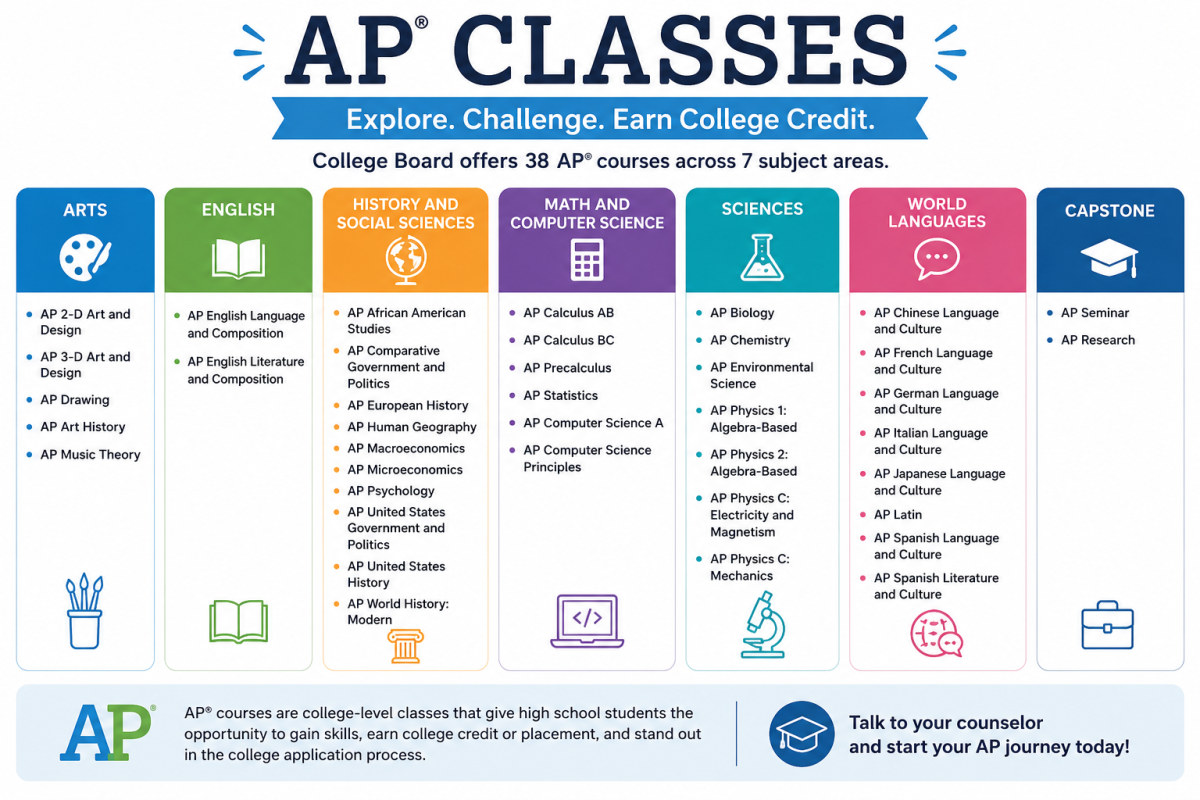
Advanced Placement courses, developed by the College Board, are designed to provide a high-level and extensive curriculum mirroring the expectations and rigor of study required at the university-level.
Compared to a regular high school course, AP classes offer a challenging environment that demands students to critically think, analytically write, and independently research.
From the view of a teacher facilitating said courses at FHS, Tyler Faetz, it has also been emphasized that, “One of the most rewarding things I have had the opportunity to do at FHS is to teach AP Literature and Composition. Unlike other classes, AP classes are special in that they tend to draw the most inquisitive and talented of students. Also, AP classes are designed based on College Board national standards, so it gives students an opportunity to work off of the same curriculum as other AP classes across the country. While the resources may look different, students from Iotla Valley are taking the same class as their peers in Silicon Valley.”
The implementation of a national standard ensures that students are learning more than just localized content, and that learning is catered via a program and curriculum that extends far beyond the borders of a small town like Franklin, NC.
This rigor is essential in leveling the playing field for that of a high school student graduating and hoping to compete with peers that have attended the most prestigious schools nationwide.
AP Course availability allows for an unbiased benchmark to be set and examined by college admissions officers, establishing not just a standard of excellence, but also a status that can be recognized and respected far outside Franklin High School.
A variety of sources note that, “While dual enrollment classes through community colleges [also offered via FHS and SCC programs] allow students access to some entry-level college courses, nothing can truly compete with the AP experience as the “gold standard” through which students can obtain college credit as well as high school credit.”
Dual Enrollment credit is only guaranteed to transfer to colleges within the state of North Carolina, while AP Credit is nationally recognized and accepted at any college across the country.
Ultimately, the environment and intention of an AP course provides a dynamic rarely accessible at the high school level.
Faetz also detailed that, “Teaching AP students allows you to establish a rapport with students that looks much different than in other classes. As I have the luxury of teaching AP seniors, the level of maturity and preparation that students generally demonstrate allows for a greater range of conversation and engagement. For many of us who prepared to teach high school, this is precisely the experience we had in mind when we chose teaching as a profession.”
It is also undeniably true that, while students ultimately benefit and put their fair share of time and effort into an AP course, the course’s implementation does require a significant undertaking via faculty members looking to teach said courses.
AP courses require a higher level of commitment from teachers than generally garnered, Emily Awtrey said, “Teaching AP is one of the most rewarding and challenging classes to teach. Yes, you get students that are very motivated and ready for college level work but that also means the prep work and planning material is much more challenging. There is also a lot of pressure knowing how much students care about passing the AP test and how serious students take the test. That’s a lot of stress on teaching a course to make sure that I do a good job covering all the material and have explained everything well.”
Despite pressures of the course, and administrating it the consensus among AP teachers remains evident: “I do think AP classes are aligned with college level rigor so students planning to further their education should definitely consider taking some AP courses while in high school to help prepare them for what is to come.”
The desire for furthering our AP curriculum and opportunities is not simply a call from teachers and administration, it is a message that resounds throughout the student body.
Students who want to challenge themselves, whether that be intellectually or by whatever means of their choice, should be given the opportunity to do so.
If that means adding more AP courses to Franklin High Schools class options, then that is a fairly feasible solution.
Students all have individual passions and interests, while one student may desire the implementation of an AP Chemistry another may want to see an AP Economics or AP Art.
All students should have the chance to take an AP they find interesting or stimulating to some degree.
Students can’t ask for things they don’t know about, and if they are willing to ask for something with sincere interest, and in hopes of helping not just themselves, but others as well, it should be acknowledged and advanced.
Thatcher Daniels, Grade 10, said, “Before high school I had little to no interest in trying to actually push myself or take rigorous classes. Near the end of my freshman year I learned about AP Government and Politics and AP Precalculus. They sounded fun so I decided to take them and now I’m glad I did; I learned a lot more than I have in any other class. After taking those classes I realized that Franklin doesn’t actually offer a lot of AP’s which hurts students that want to get into competitive colleges. My junior year I’m hoping to push to get more AP’s incorporated for those students to take.”
It is undeniable that AP courses bridge the gap between the typical structure of a high school classroom and the required rigor of a college course. Courses like these which foster independence, accountability, and academic excellence should never go on the back burner.
Franklin does not need to get left behind when it comes to providing their students with the utmost means of success, and the easiest way to fill the need is through the incorporation of AP classes.